No. of Recommendations: 7
What a marvelously useful insight. I'll be investing accordingly. Of course, it's too much to hope for an equal-weighted S&P 600 index, isn't it?To cut to the chase, there would be no discernable difference between an equal-weight small cap and the ordinary small cap index. If you, similarly, chart an a small cap index (such as IJR) and an equal weight S&P500 index (such as RSP) together over many decades, then you will find their performance is incredibly correlated (other than the last 3 years in which small caps are particularly out of favour right now, though they will mean revert as just trading at low earnings multiples today - this is an argument to move
in to rather than
out from small caps right now).
The corollary is that when you moved from the S&P500 (SPY) to an equal-weight S&P500 (RSP), nearly all of the outperformance you receive with the equal-weight index isn't from the equal weight concept itself, but rather from the fact that the large caps are being profoundly de-emphasized (such much so, that the effect is close to removing the largest 5% of the holdings completely from the index).
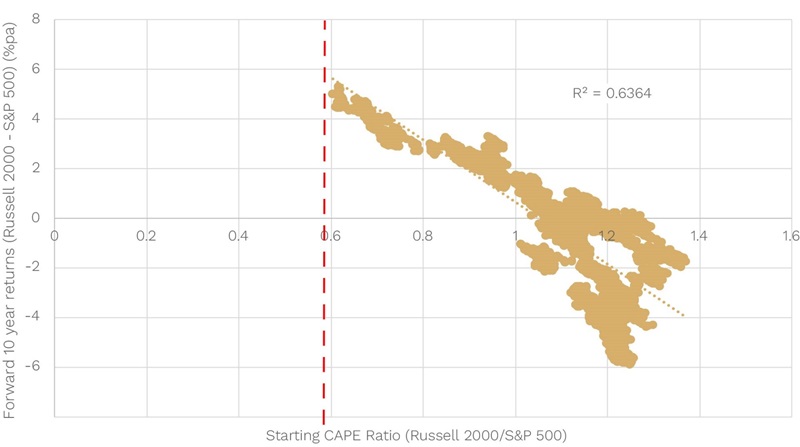
Those statements above apply at any random time in the past history when considering long-term returns from that average starting point. However, right now is not an average starting point - the situation is more extreme as this chart shows:
firstlinks.com.au - Am valuations returnsWithin this diagram, on average in the past, the red line was
by definition in the middle of the cluster. Because it is extremely far to the left, it will deviate back to the middle of the cluster at
some point in time. Even if it takes 10 years to move to the centre of the cluster,
you will receive an S&P500 market outperformance of 5% whilst waiting. If it returns faster than 10-years, then your annual outperformance will be more than 5%.
So it was always a good idea to hold an S&P600 (or even an Russell 2000 index - basically any index that simply avoids the large caps, it frankly doesn't matter which one) instead of the S&P500, but
it is an especially good time to hold such a small (or anyway non-large-cap) index right now.
- Manlobbi